
Choosing between VPS hosting and cloud hosting is one of the most common decisions businesses face when moving beyond shared hosting. Both options offer better performance, stronger security, and more control—but they are built on completely different infrastructure models.
At first glance, they may look similar because both provide scalable hosting environments. But under the surface, VPS and cloud hosting work in very different ways, and those differences directly impact performance, uptime, pricing, and long-term scalability.
In this guide, we’ll break down VPS vs cloud hosting in a simple, practical way so you can confidently decide which one fits your website, business model, and growth plans—especially if you are building or scaling a business in competitive markets like the UAE.
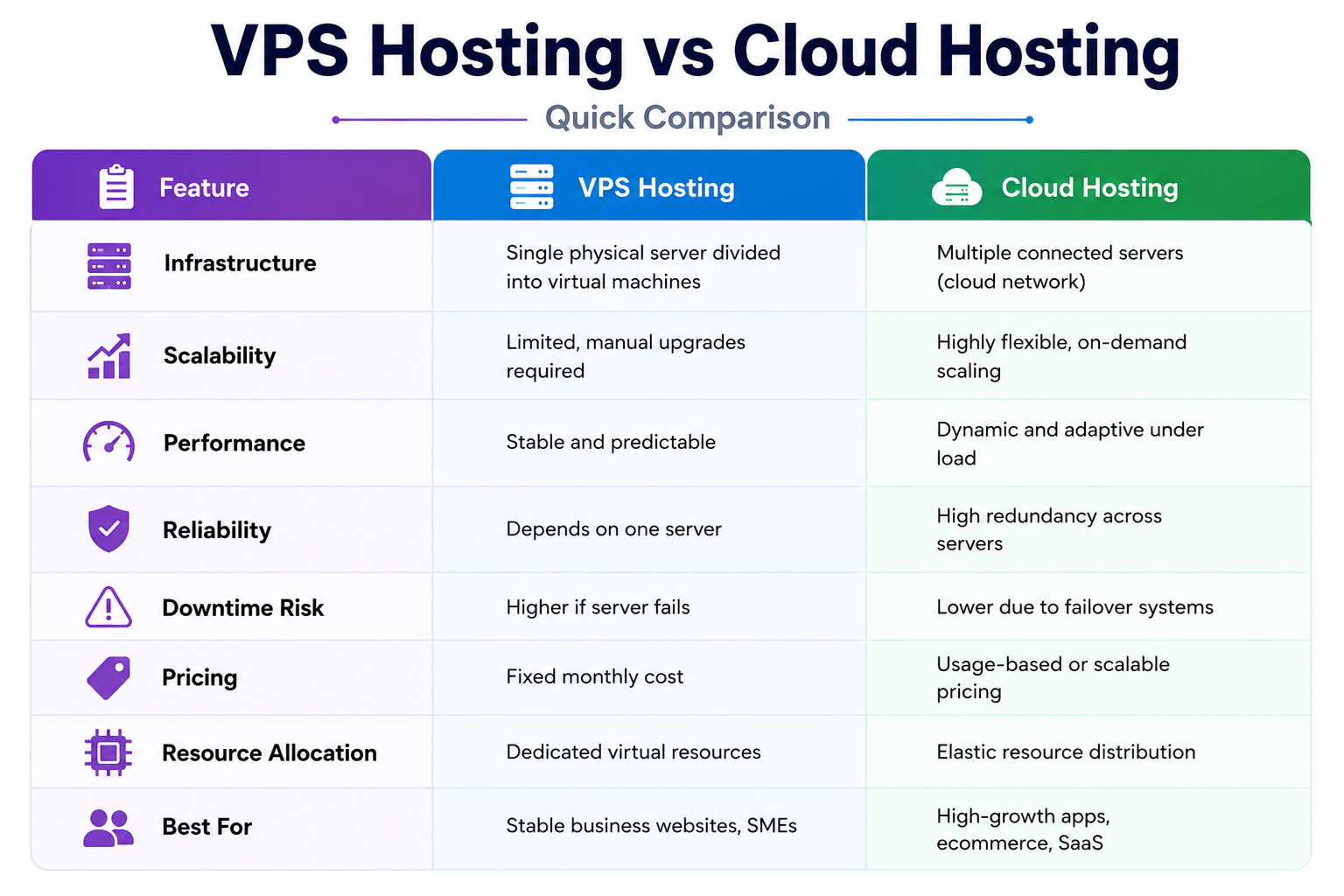
Quick VPS vs Cloud Hosting Comparison
Before going deep, here’s a clear side-by-side comparison:
Feature | VPS Hosting | Cloud Hosting |
Infrastructure | Single physical server divided into virtual machines | Multiple connected servers (cloud network) |
Scalability | Limited, manual upgrades required | Highly flexible, on-demand scaling |
Performance | Stable and predictable | Dynamic and adaptive under load |
Reliability | Depends on one server | High redundancy across servers |
Downtime Risk | Higher if server fails | Lower due to failover systems |
Pricing | Fixed monthly cost | Usage-based or scalable pricing |
Resource Allocation | Dedicated virtual resources | Elastic resource distribution |
Best For | Stable business websites, SMEs | High-growth apps, ecommerce, SaaS |
This table alone answers the core intent for most searchers, but let’s understand what it really means in practice.
What Is VPS Hosting?
Virtual Private Server Hosting
VPS (Virtual Private Server) hosting is a setup where one physical server is divided into multiple isolated virtual environments. Each user gets a dedicated portion of resources such as CPU, RAM, storage, and operating system control.
Even though multiple users share the same physical machine, each VPS behaves like an independent server.
How VPS Hosting Works (Simple Explanation)
Think of a large building divided into apartments. The building is shared, but each apartment has its own space, utilities, and privacy.
Similarly:
- One physical server = the building
- VPS instances = individual apartments
- Your resources = your private space
Key Characteristics of VPS Hosting
- Dedicated virtual resources
- Root access (full control)
- Stable performance
- Strong isolation from other users
- Predictable monthly pricing
Best Use Cases
VPS hosting is ideal for:
- Business websites with stable traffic
- WordPress websites with optimization needs
- Agencies hosting multiple clients
- Developers needing server control
- Medium-sized ecommerce stores
When VPS Hosting May NOT Be Ideal
- Sudden viral traffic spikes
- Applications needing instant scaling
- Global distributed systems
- Enterprise workloads requiring redundancy
What Is Cloud Hosting?
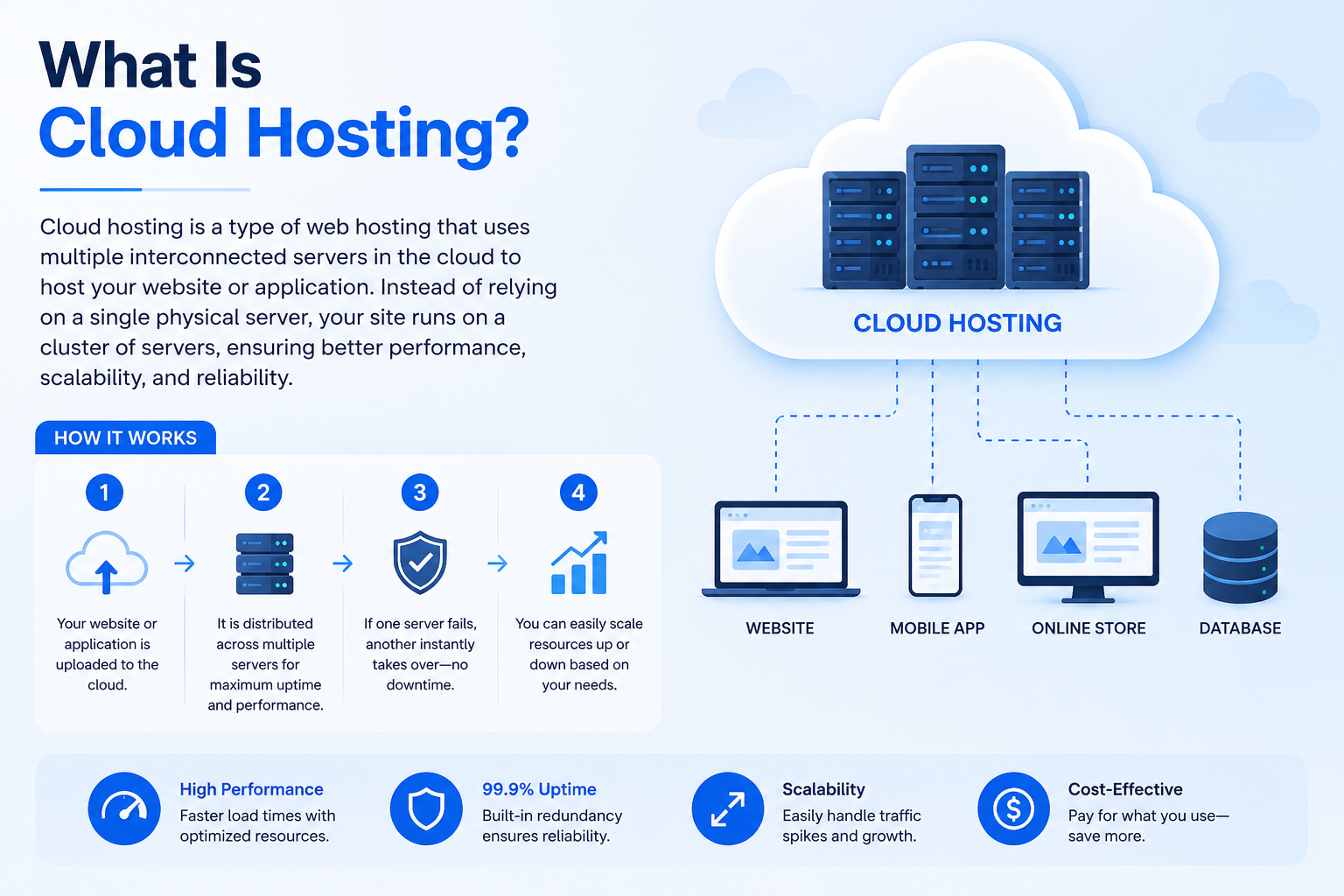
Cloud hosting is a modern infrastructure model where websites and applications run on a network of interconnected servers instead of relying on a single physical machine.
This distributed system allows resources to be shared dynamically, meaning your website can pull CPU, RAM, and storage from multiple servers depending on demand.
How Cloud Hosting Works (Simple Explanation)
Imagine a national electricity grid.
Instead of depending on one power station, electricity is supplied from many sources. If one source fails, others continue delivering power.
Cloud hosting works the same way:
- Multiple servers = power grid
- Your website = connected device
- Resources = dynamically allocated power
Key Characteristics of Cloud Hosting
- Distributed infrastructure
- High scalability
- Built-in redundancy
- Flexible resource allocation
- High uptime potential
Best Use Cases
Cloud hosting is ideal for:
- High-traffic ecommerce platforms
- SaaS applications
- Startups expecting rapid growth
- API-based systems
- Enterprise-level websites
- Seasonal traffic websites (sales/events)
When Cloud Hosting May NOT Be Ideal
- Very small websites with fixed traffic
- Businesses wanting fixed predictable billing
- Projects with minimal scaling needs
- Users who prefer simple server management
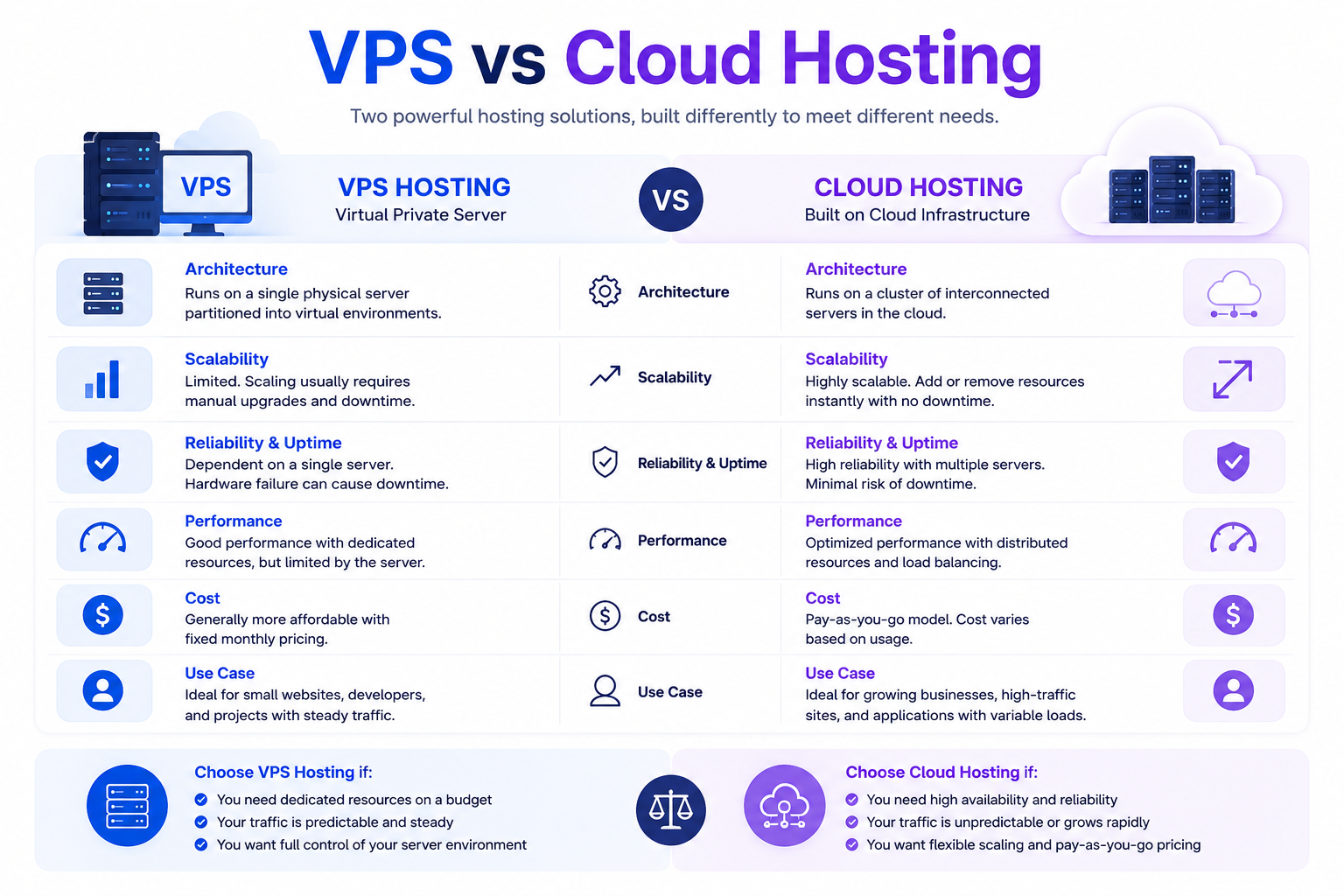
VPS vs Cloud Hosting: Core Infrastructure Difference
The fundamental difference is simple:
VPS hosting = one server divided into multiple virtual environments
Cloud hosting = multiple servers working together as one system
This difference affects everything:
- uptime
- performance stability
- scaling behavior
- pricing model
- fault tolerance
Scalability: Fixed vs Elastic Growth
VPS Hosting Scalability
VPS hosting scales vertically. This means:
- You upgrade CPU, RAM, or storage
- You move to a larger plan
- Scaling may require brief downtime or migration
It works well—but has limits based on a single machine.
Cloud Hosting Scalability
Cloud hosting scales horizontally:
- Resources can be added instantly
- Traffic spikes are handled dynamically
- No dependency on a single machine
This makes cloud hosting ideal for unpredictable workloads.
Performance Under Real Traffic Conditions
VPS Performance Behavior
VPS hosting provides:
- Consistent performance
- Dedicated resource allocation
- Predictable speed under normal load
It performs very well when traffic is stable.
Cloud Performance Behavior
Cloud hosting provides:
- Adaptive performance scaling
- Better handling of sudden spikes
- Distributed load balancing
It performs better under fluctuating or high-volume traffic.
Reliability and Uptime
VPS Reliability
VPS depends on a single physical server. Even with backups and monitoring:
- Hardware failure can affect all VPS instances on that machine
- Downtime risk is higher compared to distributed systems
Cloud Reliability
Cloud hosting uses redundancy:
- Multiple servers share workload
- Failover systems activate automatically
- If one server fails, another continues service
This results in significantly higher uptime potential.
Traffic Spike Handling
VPS Hosting
- Limited by allocated server resources
- Traffic spikes may slow performance
- Requires manual scaling or upgrades
Cloud Hosting
- Automatically adjusts resources
- Handles sudden spikes smoothly
- Ideal for viral content, ads, or sales campaigns
Security Differences
Both VPS and cloud hosting can be highly secure, but their models differ.
VPS Security
- Strong isolation between users
- Full root control
- Custom firewall configurations
- Predictable environment
Cloud Security
- Distributed security layers
- Centralized monitoring systems
- Automatic failover protection
- Enterprise-grade infrastructure options
Cost Comparison
VPS Hosting Costs
VPS hosting typically offers:
- Fixed monthly pricing
- Predictable billing
- Easier budget planning
Cloud Hosting Costs
Cloud hosting usually follows:
- Pay-as-you-go model
- Usage-based billing
- Flexible scaling costs
Important insight:
Cloud hosting can be cost-efficient—but can also become expensive if not monitored properly.
Real-World Examples
Example 1: VPS Hosting Scenario
A Dubai-based consulting company runs a corporate website with steady traffic.
- Traffic is predictable
- Pages are mostly informational
- Performance needs are stable
👉 VPS hosting is the better choice due to cost efficiency and stability.
Example 2: Cloud Hosting Scenario
An ecommerce store running seasonal campaigns across UAE experiences:
- sudden traffic spikes during sales
- marketing-driven traffic bursts
- high checkout load
👉 Cloud hosting is better due to elastic scaling and high availability.
Quick Decision Guide
Choose VPS Hosting If:
- You want predictable monthly cost
- Your traffic is stable
- You need dedicated resources
- You prefer simpler management
- You run small to medium websites
Choose Cloud Hosting If:
- Your traffic fluctuates
- You expect rapid growth
- You need high uptime guarantees
- You run SaaS or ecommerce platforms
- You require elastic scaling
Migration Considerations
Many businesses start with VPS hosting and later move to cloud infrastructure.
Signs You Should Upgrade from VPS to Cloud:
- frequent traffic spikes
- slow performance during peak hours
- scaling limitations
- business expansion into new markets
Migration usually involves:
- data transfer
- application optimization
- DNS switching
- performance testing
Proper planning ensures minimal downtime.
Common Misconceptions
“Cloud Hosting is always faster”
Not true.
A well-optimized VPS can outperform a poorly configured cloud setup.
Performance depends on:
- server optimization
- caching
- storage type (SSD/NVMe)
- application design
“VPS cannot scale”
VPS can scale—but not instantly like cloud systems.
It requires upgrades or migration.
“Cloud hosting is unlimited”
Cloud hosting is highly scalable—but still limited by:
- provider infrastructure
- pricing tiers
- configuration
Internal Hosting Ecosystem (Important for Business Growth)
In real-world infrastructure planning, hosting rarely works alone.
Businesses often combine:
- VPS hosting for core websites
- cloud hosting for scalable applications
- domain registration services for branding
- business email hosting for communication
- dedicated server hosting for enterprise workloads
- Google Workspace solutions for collaboration
This layered approach builds a stable, scalable digital foundation.
Final Verdict: VPS vs Cloud Hosting
Both hosting types are powerful—but they solve different problems.
- VPS hosting focuses on control, stability, and predictable performance
- Cloud hosting focuses on scalability, redundancy, and flexibility
There is no universal winner.
Instead, the right choice depends on your:
- traffic behavior
- budget structure
- technical needs
- growth expectations
For most small to medium businesses, VPS hosting is a strong starting point. For fast-scaling or high-traffic platforms, cloud hosting becomes the more future-proof infrastructure model.
Choosing correctly at the right stage can significantly improve your website’s performance, cost efficiency, and long-term scalability.