
Choosing between cPanel and Plesk is one of the most important decisions in web hosting. Whether you are running a small business website, managing WordPress projects, or handling VPS servers, the control panel you choose directly affects your workflow, speed, and long-term scalability.
Both cPanel and Plesk are globally trusted platforms used by hosting companies, developers, and agencies. However, they are designed for slightly different types of users and hosting environments.
In this guide, we will break down the real differences between them so you can confidently decide which one fits your needs best in 2026.
CreativeON.com and CreativeON.ae bring over 20 years of hosting infrastructure experience in VPS hosting, cloud environments, dedicated servers, and business email solutions, helping businesses choose the right hosting foundation.

What Is a Hosting Control Panel?
A hosting control panel is a web-based dashboard that allows you to manage your hosting environment without technical commands.
Instead of using terminal commands, you can control everything visually, including:
- Websites and domains
- Email accounts
- SSL certificates
- File management
- Databases
- Backups
- Security settings
It acts as the central management system of your hosting account.
What Is cPanel?
cPanel is a Linux-based hosting control panel widely used in shared hosting environments.
Who Uses cPanel?
- Beginner website owners
- Shared hosting users
- WordPress bloggers
- Reseller hosting providers
- Traditional Linux hosting environments
Why cPanel Became Popular
- Very easy to learn
- Massive global adoption
- Strong documentation ecosystem
- Stable and proven hosting standard
What Is Plesk?
Plesk is a modern hosting control panel designed for both Linux and Windows environments.
Who Uses Plesk?
- Web developers
- Agencies managing multiple websites
- VPS and cloud hosting users
- Windows hosting users
- Advanced WordPress users
Why Plesk Is Popular
- Clean and modern interface
- Strong developer tools
- Cross-platform (Linux + Windows)
- Better automation and integrations
Why This Comparison Matters in 2026
The hosting industry has changed significantly:
- VPS and cloud adoption is growing
- WordPress ecosystems are more complex
- Developers need automation tools
- Agencies manage multiple client systems
- Security expectations are higher
- Cost optimization matters more than ever
So choosing the right control panel directly affects:
- Productivity
- Scalability
- Hosting cost efficiency
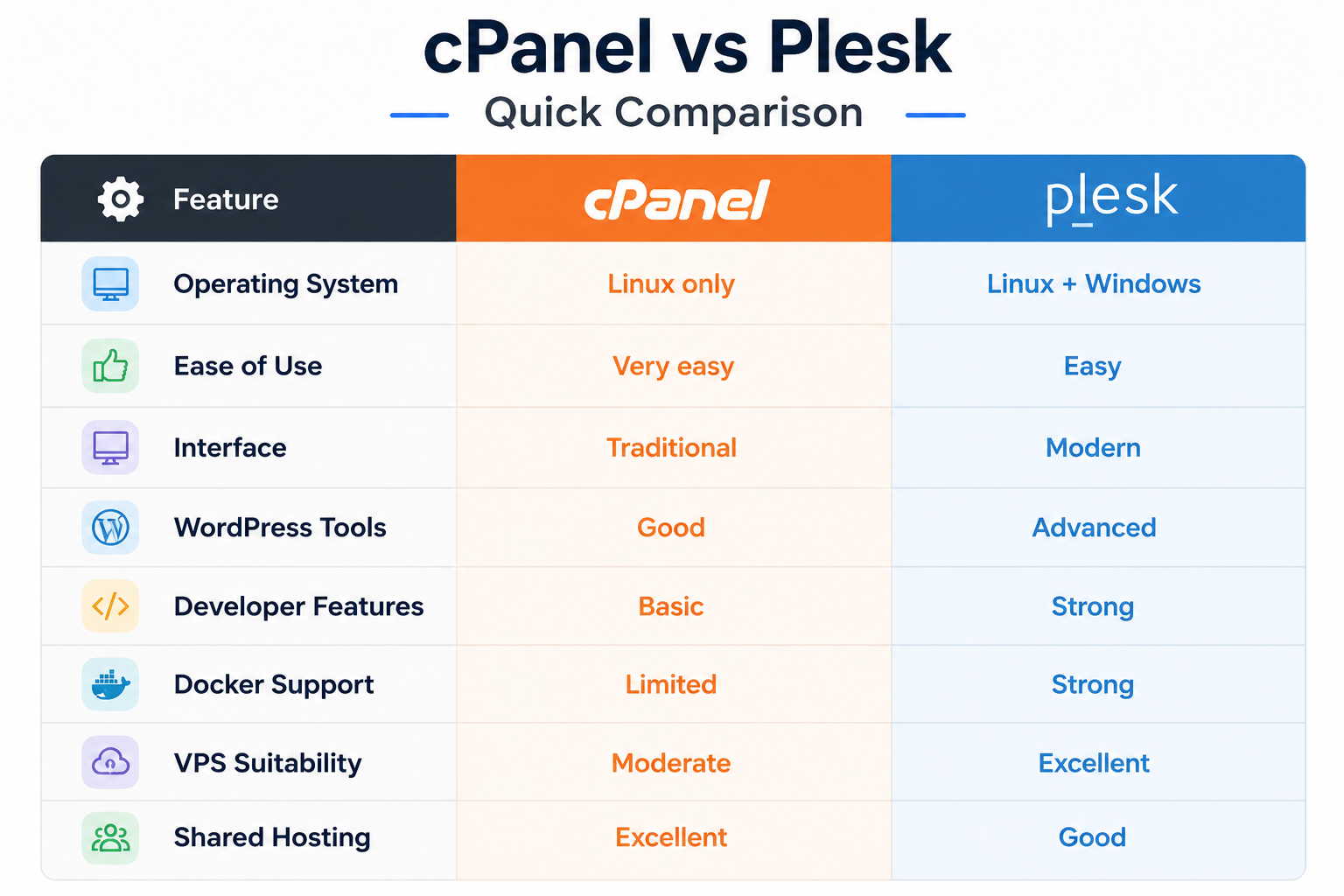
cPanel vs Plesk Quick Comparison
| Feature | cPanel | Plesk |
|---|---|---|
| Operating System | Linux only | Linux + Windows |
| Ease of Use | Very easy | Easy |
| Interface | Traditional | Modern |
| WordPress Tools | Good | Advanced |
| Developer Features | Basic | Strong |
| Docker Support | Limited | Strong |
| VPS Suitability | Moderate | Excellent |
| Shared Hosting | Excellent | Good |
User Interface Comparison
cPanel Interface
cPanel uses a structured icon-based layout that is familiar to most hosting users.
Strengths:
- Easy navigation
- Beginner friendly
- Widely documented
Limitation:
- Slightly outdated visual design
Plesk Interface
Plesk provides a modern dashboard experience designed for productivity.
Strengths:
- Clean UI
- Better workflow management
- Ideal for multiple websites
Limitation:
- Slight learning curve for beginners
Operating System Support
cPanel
- Works only on Linux servers
Plesk
- Works on Linux and Windows servers
Plesk is more flexible for enterprise environments.
Real-World Use Cases
Best for Beginners
- Launching first website
- Using shared hosting
- Following tutorials
Best for Agencies
- Managing multiple clients
- WordPress development
- Staging environments
Best for Developers
- Git workflows
- Docker applications
- Node.js / Python hosting
Best for Small Businesses
- cPanel → Simple and affordable
- Plesk → Scalable and modern
WordPress Management
cPanel WordPress Features
- One-click installer
- Basic management
- Manual updates
Plesk WordPress Toolkit
- Staging environments
- Security hardening
- Bulk updates
- Cloning tools
Plesk is more powerful for WordPress professionals.
Performance Considerations
Control panels do NOT directly affect speed.
Performance depends on:
- CPU and RAM
- NVMe SSD storage
- Caching systems
- CDN integration
Key insight:
- cPanel → lighter for shared hosting
- Plesk → better for VPS/cloud scaling
Security Comparison
cPanel
- Imunify360 integration
- Firewall support
- ModSecurity protection
Plesk
- Centralized updates
- Docker security
- WordPress hardening
Both are secure when properly configured.
Developer Features
Plesk Advantages
- Git integration
- Docker support
- Node.js / Python support
- Automation tools
cPanel Strengths
- Stable PHP hosting
- Simple deployment
- Traditional workflow
Email Hosting
Both support full email hosting:
- Business email accounts
- Spam filtering
- Webmail access
- Forwarding
Many businesses also use Google Workspace for professional email solutions.
Pricing Reality
cPanel
- Licensing costs increased
- Affects hosting pricing
Plesk
- Flexible licensing
- Better VPS scalability
Migration Between cPanel and Plesk
Common challenges:
- Email migration
- File structure differences
- Database compatibility
- DNS propagation
Pros and Cons
cPanel Pros
- Beginner friendly
- Widely supported
- Strong ecosystem
cPanel Cons
- Linux only
- Limited modern tools
Plesk Pros
- Multi-platform
- Strong developer tools
- Modern interface
Plesk Cons
- Learning curve
- Extension-based system
Final Recommendation
Choose cPanel if:
- You are a beginner
- You use shared hosting
- You want simplicity
Choose Plesk if:
- You are a developer or agency
- You need Windows hosting
- You manage multiple websites
Final Verdict
There is no universal winner between cPanel and Plesk.
- cPanel is best for simplicity and shared hosting
- Plesk is best for flexibility and modern development
The right choice depends on your use case, not popularity.
A good hosting provider matters just as much as the control panel itself.
CreativeON.com and CreativeON.ae provide VPS hosting, cloud solutions, dedicated servers, and business email services built for performance and scalability.