

Introduction
Every business email you send carries something more important than just a message—it carries your brand identity.
When a customer receives an email from yourname@gmail.com, it feels personal. But when they receive an email from yourname@yourcompany.com, it instantly signals trust, structure, and professionalism.
This is exactly what email hosting enables.
Email hosting is the infrastructure that allows businesses to run email accounts on their own domain with secure servers, full control, and professional delivery systems. It powers everything behind the scenes—from sending emails to protecting them from spam and phishing.
For businesses using infrastructure providers like CreativeON.com and UAE-focused solutions from CreativeON.ae, email hosting becomes part of a complete digital business ecosystem that includes hosting, security, and communication systems.
What Is Email Hosting?
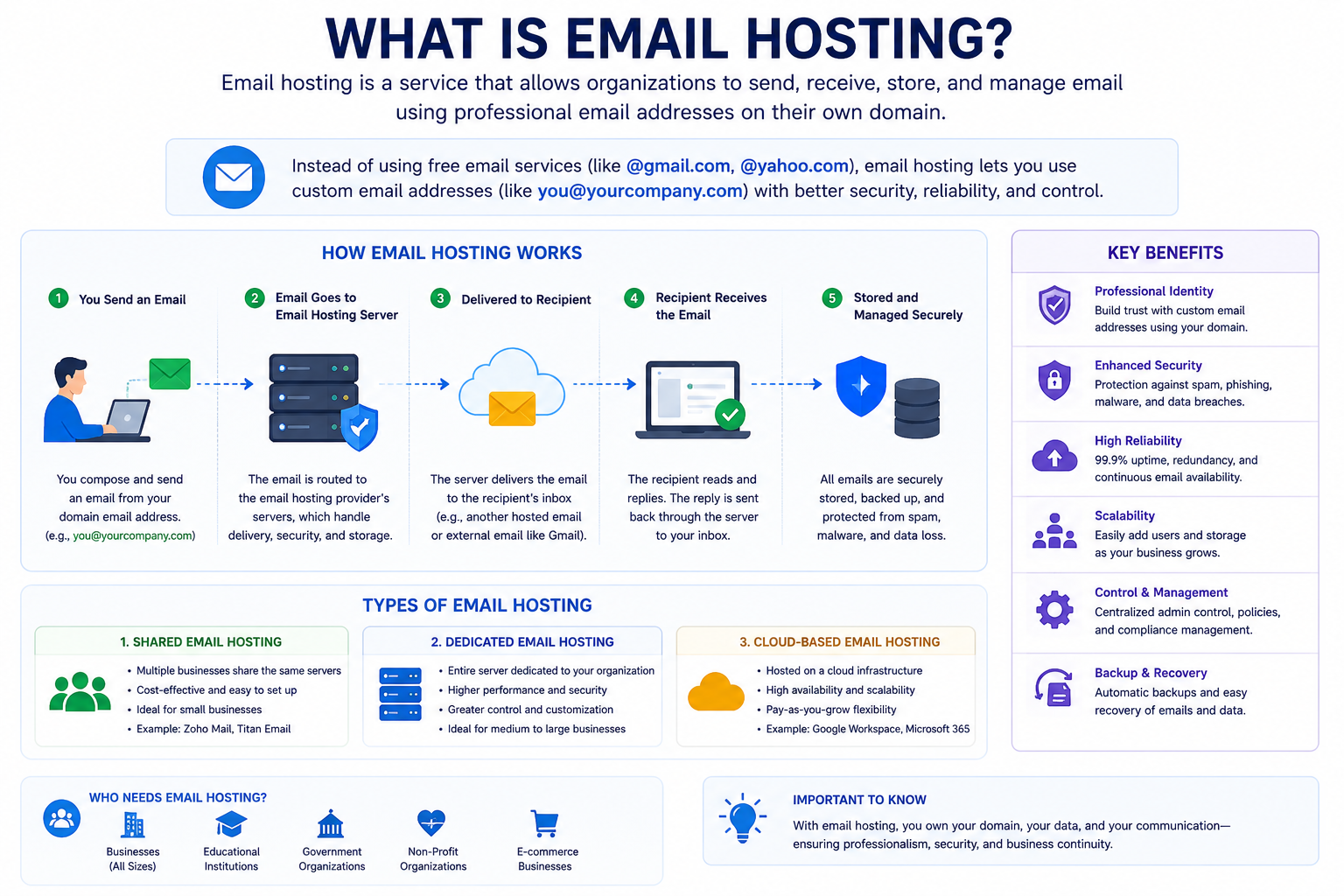
Email hosting is a service that allows businesses to create and manage email accounts using their own domain name while storing and processing emails on dedicated mail servers.
Instead of relying on free platforms like Gmail or Yahoo, email hosting gives you:
- Custom domain email addresses (e.g., info@yourbusiness.com)
- Dedicated or cloud-based mail servers
- Full control over email accounts and security
- Business-grade reliability and uptime
At its core, email hosting is the “engine” that makes professional email communication possible.
Without it, your domain cannot send or receive emails independently.
How Email Hosting Works (Behind the Scenes)
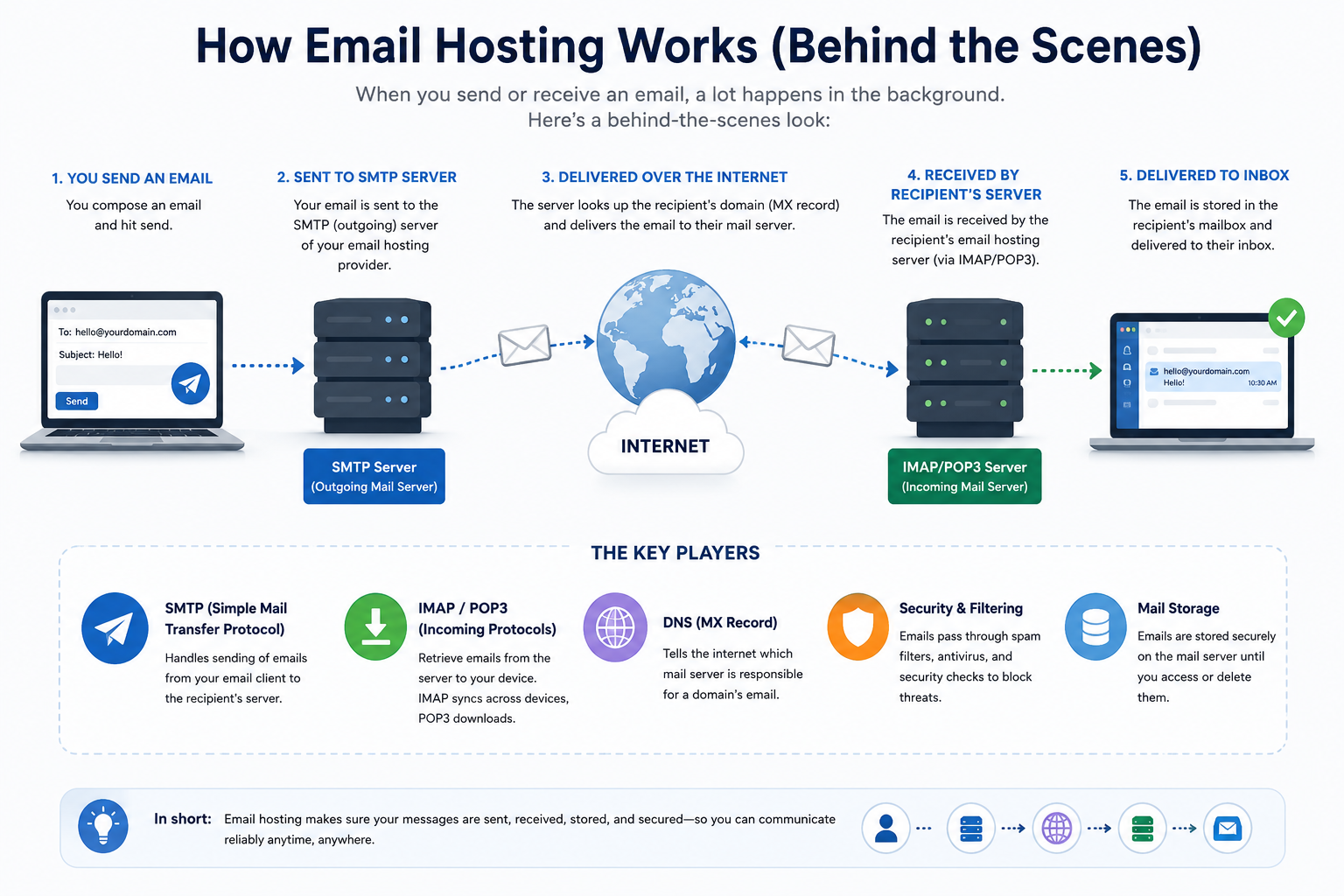
Even though email feels instant, there is a structured system working behind every message.
Let’s break it down simply.
1. Sending an Email (SMTP Process)
When you click “Send,” your email client connects to the outgoing mail server using:
SMTP
SMTP (Simple Mail Transfer Protocol) is the standard system that transfers emails between servers.
Here’s what happens next:
- Your email is sent to your hosting provider’s mail server
- The server identifies the recipient’s domain
- It checks DNS records to find where to deliver the email
2. MX Record Lookup (Delivery Routing)
The system checks MX (Mail Exchange) records in DNS to find the correct destination server.
These records act like a “postal guide” for emails, telling the internet where your messages should go.
Without MX records, email delivery would not be possible.
3. Receiving Emails (IMAP vs POP3)
Once the email reaches the recipient server, it is stored and accessed using one of two protocols:
IMAP (Modern Standard)
- Emails stay on the server
- Syncs across all devices
- Best for businesses
POP3 (Legacy Method)
- Downloads emails to one device
- Removes them from server
- Less commonly used today
Most modern systems default to IMAP because businesses need multi-device access.
4. Email Storage
All emails are stored inside your hosting mailbox on secure servers.
Storage depends on your plan:
- Basic plans: limited GBs per mailbox
- Business plans: scalable or unlimited storage
- Enterprise: high-performance distributed storage
This ensures emails are always accessible and backed up.
Types of Email Hosting Solutions
Different businesses need different levels of email infrastructure.
1. Shared Email Hosting
- Hosted on shared servers
- Budget-friendly
- Best for startups and small businesses
Ideal when email volume is low and simplicity matters more than advanced features.
2. Business Email Hosting
- Dedicated business environment
- Better security and performance
- Admin control panel included
Designed for growing companies that rely heavily on email communication.
3. Cloud Email Hosting
- Hosted on scalable cloud infrastructure
- High uptime and redundancy
- Supports remote teams
Often used in modern businesses that require flexibility and global access.
4. Enterprise Email Suites
Platforms like Google Workspace combine:
- Email hosting
- Cloud storage
- Collaboration tools
- Security management
Solutions like these, available through CreativeON.ae, provide fully managed business communication ecosystems.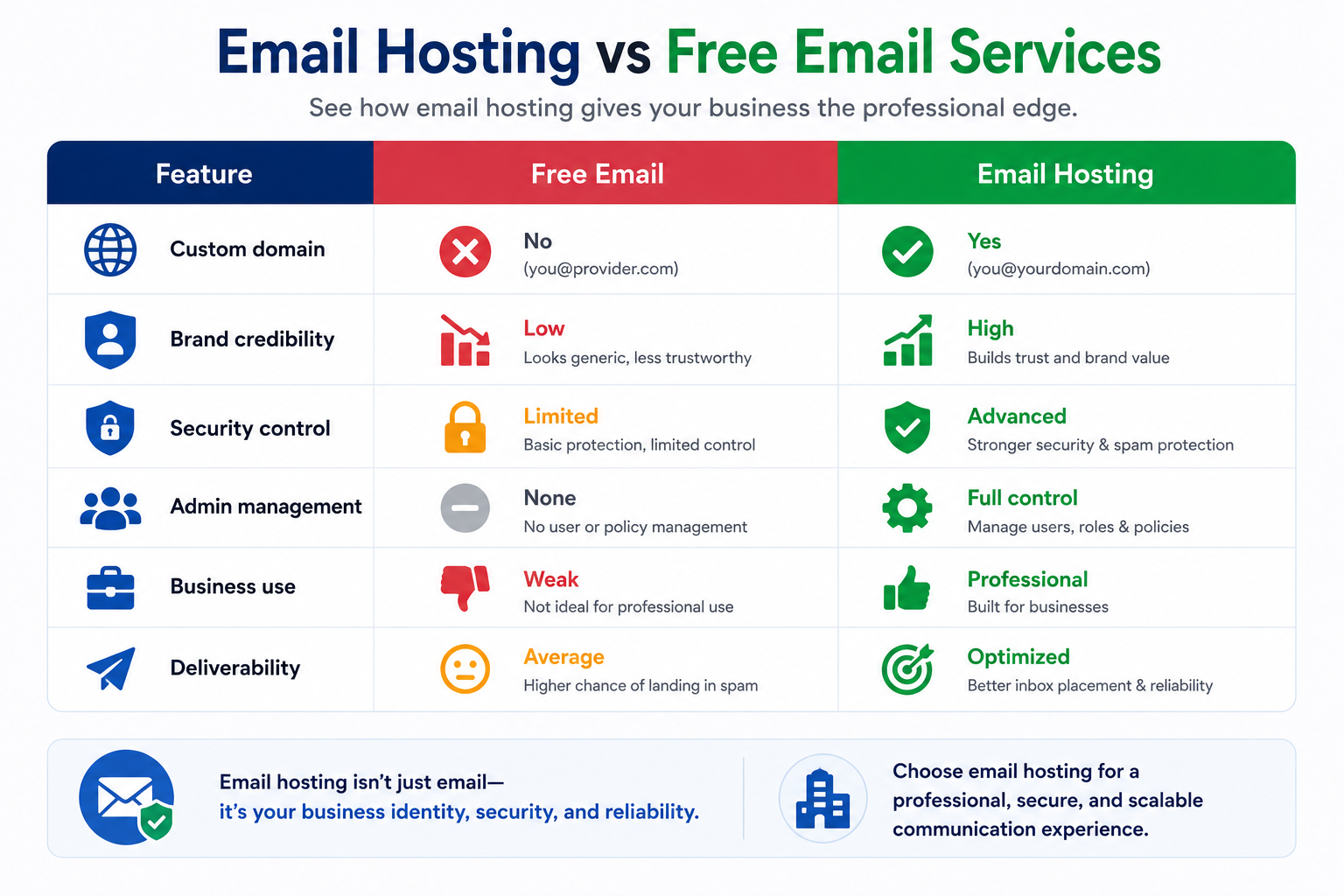
Email Hosting vs Free Email Services
The difference becomes obvious when business operations scale.
| Feature | Free Email | Email Hosting |
| Custom domain | ❌ | ✅ |
| Brand credibility | Low | High |
| Security control | Limited | Advanced |
| Admin management | None | Full control |
| Business use | Weak | Professional |
| Deliverability | Average | Optimized |
Free email is personal. Email hosting is business infrastructure.
Email Authentication (Critical for Deliverability)
Modern email systems rely heavily on authentication to prevent spam and fraud.
SPF (Sender Policy Framework)
Defines which servers are allowed to send emails on behalf of your domain.
DKIM (DomainKeys Identified Mail)
Adds a digital signature to verify email integrity.
DMARC (Domain-Based Message Authentication)
Controls how receiving servers handle failed authentication and provides reporting.
Without these three records properly configured, even legitimate emails may land in spam folders.
Why Email Hosting Matters for Businesses
Email hosting directly impacts business performance in multiple ways:
1. Brand Trust
Customers trust domain-based emails more than free email accounts.
2. Communication Security
Protects against phishing, spoofing, and spam attacks.
3. Operational Control
Admins can manage users, storage, and policies centrally.
4. Scalability
Easy to add employees and departments as the business grows.
5. Reliability
Business-grade uptime ensures uninterrupted communication.
Email Hosting in UAE Business Environment
For UAE businesses, email hosting plays an even more strategic role:
- Supports professional communication standards in competitive markets
- Ensures compliance for regulated industries
- Enables fast regional support and infrastructure reliability
Businesses across Dubai, Abu Dhabi, and the wider UAE increasingly depend on solutions from providers like CreativeON.ae for stable, managed email infrastructure.
Email Hosting vs Web Hosting
These two are often confused but serve different purposes.
Web Hosting
- Hosts your website files
- Makes your website accessible online
Email Hosting
- Manages email communication
- Routes and stores messages
They work together but operate independently.
Common Email Hosting Mistakes
Many businesses lose performance due to avoidable mistakes:
- Not configuring SPF, DKIM, and DMARC
- Using generic catch-all inboxes
- Ignoring mailbox storage limits
- Choosing low-quality hosting providers
- Not monitoring email deliverability
These issues directly affect business communication reliability.
How to Choose the Right Email Hosting
Before selecting a provider, evaluate:
- Security and encryption standards
- Uptime guarantee (99.9%+ preferred)
- Storage scalability
- Spam protection systems
- Admin control features
- Local or global support availability
A strong provider ensures your communication system scales with your business.