

Introduction
Have you ever visited a website that felt slow, even though it looked simple? Sometimes the problem is not the website itself—it is where the server is located.
Many website owners focus on design, content, and hosting plans, but overlook one important factor: server location. The physical distance between your website visitors and your hosting server can directly affect how quickly pages load.
For businesses that depend on online visibility, customer experience, and conversions, understanding how server location impacts website speed can help improve performance and user satisfaction. Whether you run an ecommerce store, company website, blog, or web application, choosing the right server location can make a noticeable difference.
What Is Server Location?
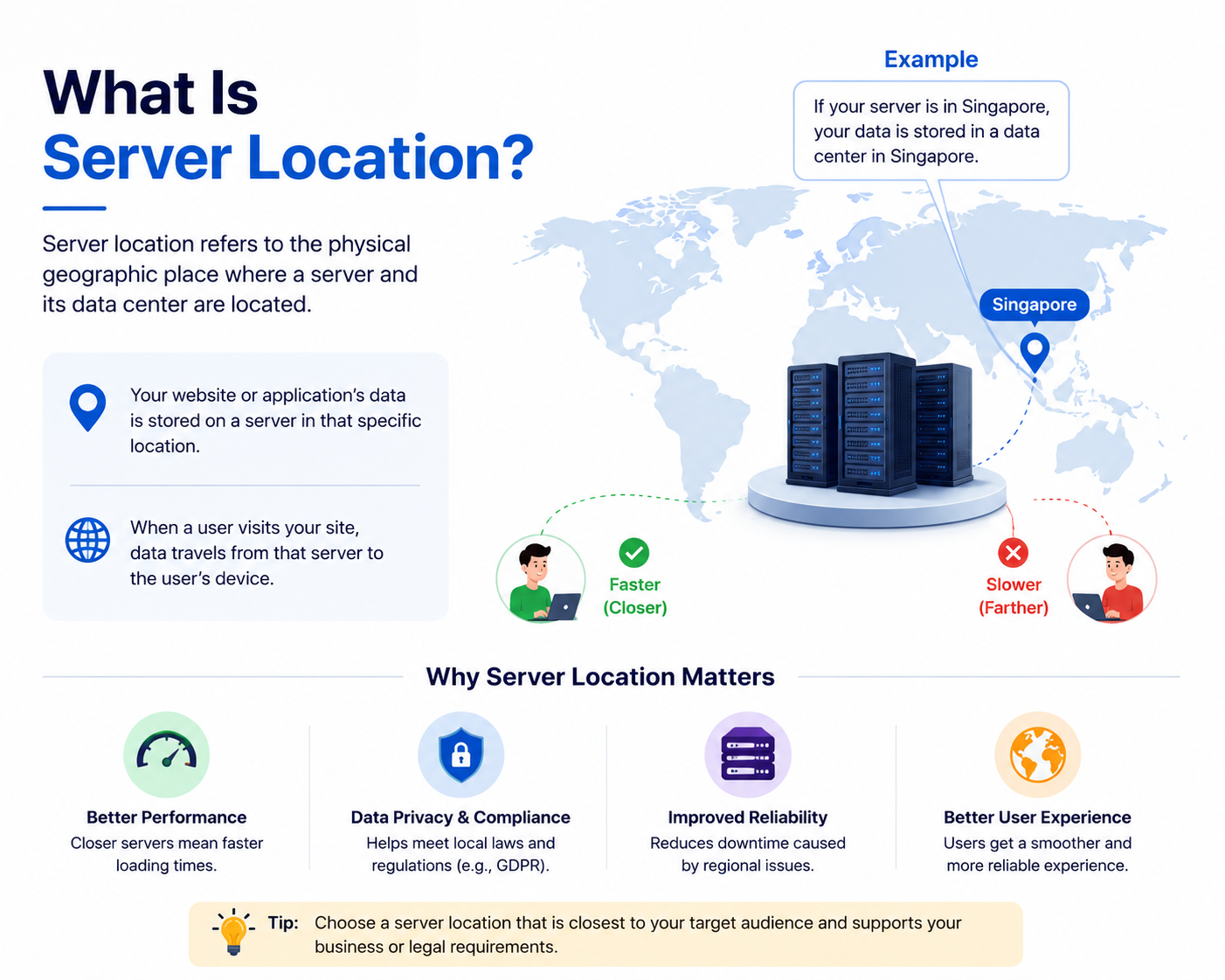
Server location refers to the physical data center where your website files, databases, and applications are hosted.
Every time someone visits your website, their browser sends a request to the server. The server then responds by delivering the required content. Although this process happens in milliseconds, the distance the data must travel still affects loading times.
For example:
- A visitor in Dubai accessing a website hosted in the UAE will generally experience faster loading times.
- The same visitor accessing a website hosted on a server in North America may experience slightly higher delays.
The greater the distance, the longer the data journey.
Understanding Latency and Why It Matters
The biggest reason server location affects website speed is latency.
Latency is the time it takes for data to travel between a user’s device and the hosting server.
Think of it like sending a package:
- Delivering a package within the same city is usually faster.
- Delivering the same package to another continent takes longer.
Internet data works in a similar way.
Even though modern networks are incredibly fast, every additional network hop and geographic distance adds small delays. When combined across multiple website requests, these delays can affect overall page load speed.
How Distance Affects Website Performance
When a visitor accesses your website, several requests are exchanged between their browser and your server.
These requests include:
- HTML files
- Images
- CSS files
- JavaScript files
- Database queries
- API responses
If the server is located far away, every request takes slightly longer to complete.
This can result in:
- Slower page loads
- Delayed content rendering
- Longer checkout processes
- Reduced responsiveness
For websites with heavy traffic or dynamic content, the impact becomes even more noticeable.
Why Server Location Matters for User Experience
Website visitors expect pages to load quickly.
Studies consistently show that users become frustrated when websites take too long to load. Even small delays can increase bounce rates and reduce engagement.
A nearby server location helps provide:
- Faster page loading
- Smoother browsing experience
- Better mobile performance
- Improved customer satisfaction
- Higher engagement rates
For ecommerce websites, speed can directly influence sales and conversion rates.
If customers experience delays while browsing products or completing purchases, they may leave before converting.
The Impact on SEO and Search Rankings
Search engines consider page experience and website performance when evaluating websites.
While server location itself is not a direct ranking factor, it can indirectly affect SEO through:
Faster Page Speed
Quicker loading websites generally provide a better user experience.
Lower Bounce Rates
Users are more likely to stay on fast-loading websites.
Better Core Web Vitals
Performance metrics such as loading speed and responsiveness contribute to search visibility.
Improved Crawl Efficiency
Search engine bots can crawl fast websites more efficiently.
For businesses targeting customers in the UAE, hosting closer to the target audience may help improve overall website performance and user engagement.
Local Audiences Benefit Most from Nearby Servers
If most of your visitors come from a specific region, choosing a nearby server often delivers the best experience.
Examples include:
UAE Businesses
Companies serving customers in:
- Dubai
- Abu Dhabi
- Sharjah
- Ajman
- Ras Al Khaimah
may benefit from hosting infrastructure located in the UAE, Middle East, or nearby regions.
Regional Ecommerce Stores
Online stores targeting GCC customers can often achieve lower latency by selecting hosting infrastructure closer to regional users.
Service-Based Businesses
Professional service providers, agencies, and local businesses frequently see better performance when hosting near their primary customer base.
What Happens When Visitors Are Global?
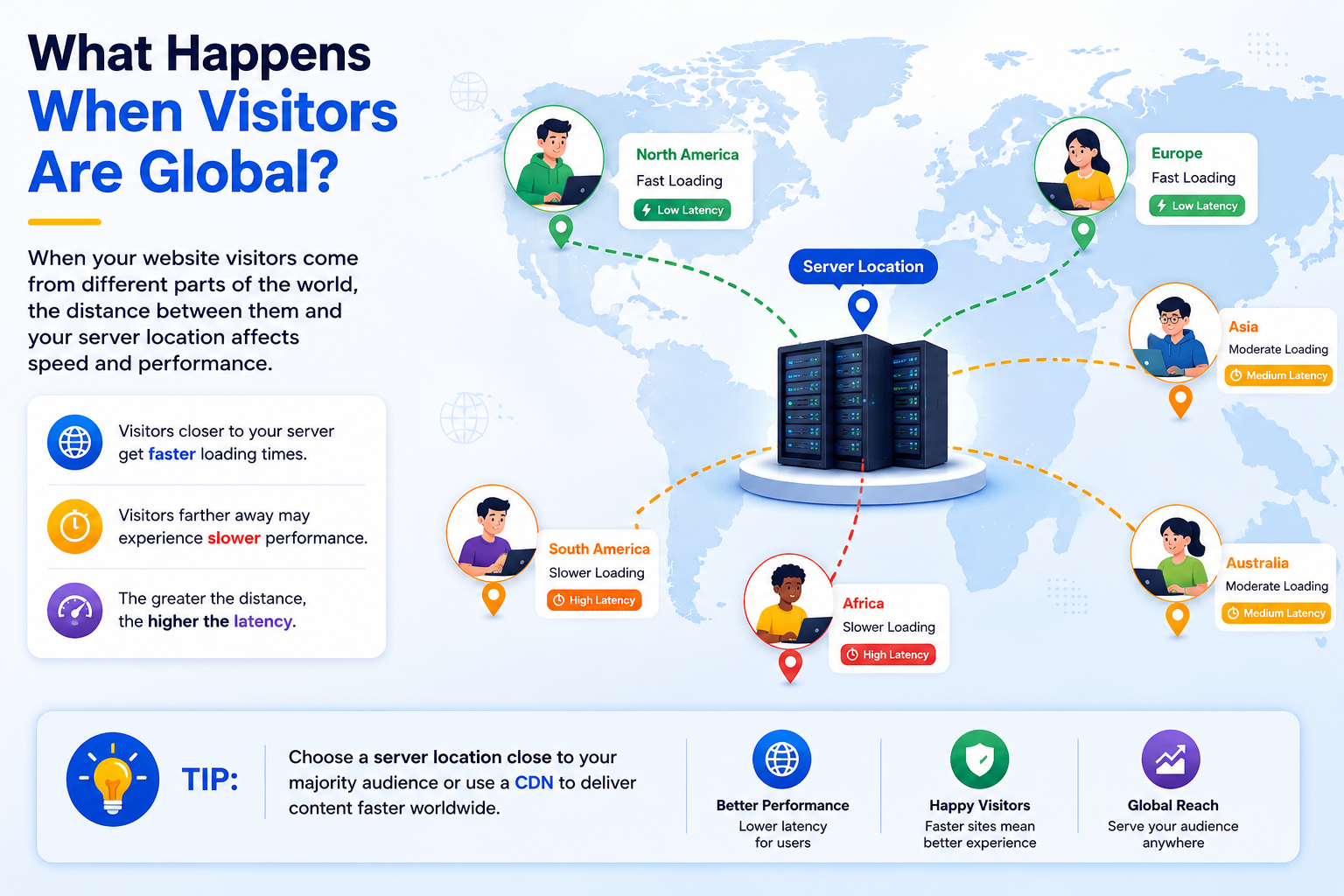
Not every website serves a local audience.
Some websites attract visitors from:
- Europe
- Asia
- North America
- Middle East
- Africa
In these cases, choosing a single server location becomes more challenging.
A server that performs well for one region may be slower for another.
This is where modern hosting technologies can help reduce geographic limitations.
How Content Delivery Networks (CDNs) Help
A Content Delivery Network (CDN) stores copies of website content on multiple servers around the world.
Instead of serving every request from one location, the CDN delivers content from the server closest to the visitor.
Benefits include:
- Reduced latency
- Faster image delivery
- Improved global performance
- Better handling of traffic spikes
- Enhanced website reliability
Many businesses combine quality web hosting services with a CDN to provide consistent performance across multiple countries.
Server Location vs Hosting Quality
Choosing the closest server is important, but it is not the only factor affecting speed.
Other performance factors include:
Storage Technology
Modern NVMe SSD hosting typically delivers faster performance than older storage systems.
Server Resources
Adequate CPU, RAM, and storage resources influence response times.
Network Infrastructure
Premium data centers usually offer faster and more reliable connectivity.
Software Optimization
Efficient web servers, caching systems, and optimized databases contribute significantly to performance.
A nearby server with poor infrastructure may perform worse than a slightly more distant server with superior hardware and network quality.
Common Mistakes When Choosing a Server Location
Many website owners make decisions based solely on price.
Some common mistakes include:
Ignoring Visitor Geography
Hosting on the opposite side of the world from your audience can increase latency.
Choosing the Cheapest Option
Low-cost hosting sometimes sacrifices network quality and performance.
Overlooking Future Growth
A business targeting UAE customers today may expand internationally tomorrow.
Not Using a CDN
Global websites often miss opportunities to improve performance through content distribution.
How to Choose the Right Server Location
The best server location depends on your audience.
Ask yourself:
Where Are Most Visitors Located?
Use analytics tools to identify visitor locations.
Is Your Audience Local or International?
Local audiences often benefit from regional hosting.
Do You Expect Global Traffic?
Consider CDN integration and scalable infrastructure.
What Are Your Performance Goals?
Prioritize speed, reliability, and user experience rather than server location alone.
For many UAE businesses, selecting reliable web hosting services in UAE combined with strong network infrastructure provides an excellent balance between performance and customer experience.
When Server Location Matters Less
Modern technologies have reduced the impact of physical distance in some situations.
Server location becomes less critical when:
- CDN services are implemented effectively
- Content is heavily cached
- Applications use distributed infrastructure
- Visitors are spread evenly across multiple regions
However, for dynamic websites and localized audiences, server proximity still plays an important role.
Best Practices for Optimizing Website Speed
To maximize website performance:
- Choose a server location close to your primary audience.
- Use a reliable hosting provider.
- Enable website caching.
- Optimize images and media files.
- Use a CDN for global traffic.
- Monitor website performance regularly.
- Upgrade resources when traffic grows.
- Keep software and applications updated.
A combination of good hosting infrastructure and proper optimization delivers the best results.
How CreativeON.ae Helps Businesses Improve Website Performance
Choosing the right server location is only one part of website performance optimization.
CreativeON.ae, the UAE-focused subsidiary of CreativeON.com, helps businesses select hosting solutions that align with their audience, performance requirements, and growth plans.
With more than 20 years of infrastructure experience, CreativeON provides:
- Web hosting services
- VPS hosting solutions
- Cloud hosting infrastructure
- Dedicated server hosting
- Domain registration services
- Business email solutions
By matching businesses with appropriate hosting environments and performance-focused infrastructure, organizations can deliver faster and more reliable experiences to their customers.