
Choosing between Windows hosting and Linux hosting is one of the most important decisions when launching a website, web application, or business platform. Both hosting environments are reliable and widely used, but they are built around very different technologies, software ecosystems, and server architectures.
For many website owners, the confusion starts with the names themselves. Some people assume Windows hosting is meant for Windows computer users, while Linux hosting is only for developers. In reality, the decision has very little to do with the operating system on your personal computer.
The real deciding factor is compatibility.
Your hosting environment should match the technologies your website or application was built on. Choosing the wrong platform can lead to software limitations, compatibility issues, unnecessary costs, or reduced flexibility later.
This guide focuses specifically on the differences between Windows hosting and Linux hosting, where each one performs best, what practical limitations exist, and how to choose the right environment based on real hosting needs.
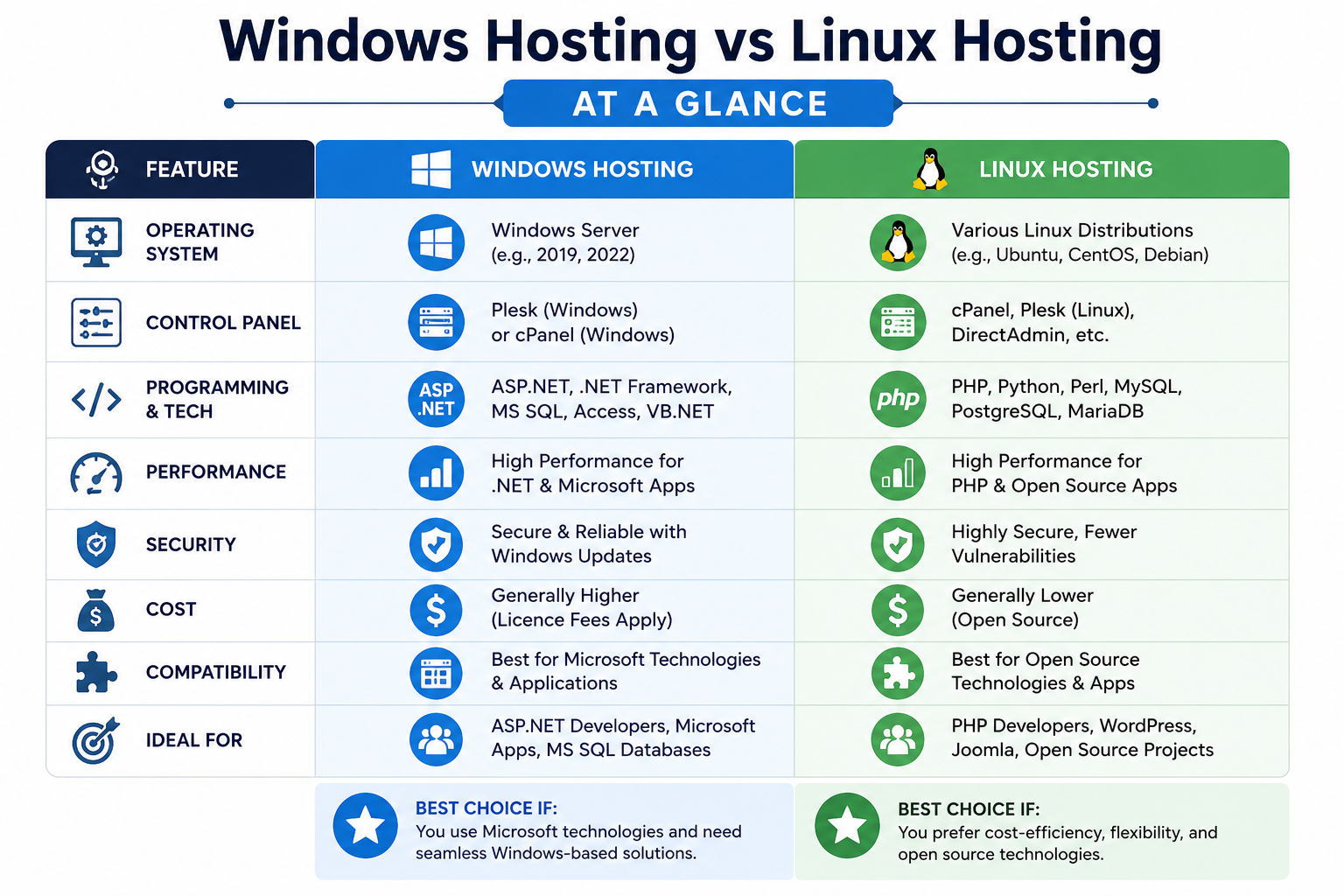
Windows Hosting vs Linux Hosting at a Glance
Before diving deeper, here’s a quick overview of the biggest differences.
Feature | Linux Hosting | Windows Hosting |
Best For | WordPress, PHP apps, open-source platforms | ASP.NET, MSSQL, Microsoft apps |
Common Server Stack | Apache, NGINX, LiteSpeed | IIS |
Database Support | MySQL, MariaDB | MSSQL, Access |
Licensing Cost | Lower | Higher |
Resource Usage | Lightweight | Higher overhead |
Popular Control Panels | cPanel, DirectAdmin, Plesk | Plesk |
Flexibility | Highly customizable | Microsoft-focused ecosystem |
Developer Preference | Open-source developers | .NET developers |
Most Common Use Case | Websites and CMS platforms | Enterprise Microsoft applications |
For most standard websites, Linux hosting is the more common choice. Windows hosting becomes important when specific Microsoft technologies are required.
The Core Difference Between Windows Hosting and Linux Hosting
The biggest difference is the operating system running on the server.
Linux hosting runs on Linux-based operating systems such as:
Windows hosting runs on Microsoft Windows Server.
That operating system affects nearly everything behind the scenes, including:
- Application compatibility
- Server software
- Database systems
- Resource usage
- Security architecture
- Administrative tools
- Development environments
Even if two websites look identical in a browser, the infrastructure powering them can be completely different depending on the hosting platform.
When Windows Hosting Makes Sense
Windows hosting is primarily designed for applications built using Microsoft technologies.
It is the preferred choice when your project depends on:
- ASP.NET
- ASP.NET Core in Windows environments
- VB.NET
- Microsoft SQL Server (MSSQL)
- IIS web server
- Microsoft Access databases
- Windows-specific frameworks
- Enterprise Microsoft integrations
Many enterprise applications are deeply integrated into Microsoft ecosystems. In these situations, Windows hosting provides better compatibility and smoother operational support.
For example, a company running an internal HR portal built using ASP.NET with MSSQL databases will typically benefit from a Windows hosting environment because the application stack was designed around Microsoft infrastructure.
Windows hosting also makes sense for organizations already using Microsoft-based development pipelines and server administration workflows.
When Linux Hosting Makes More Sense
Linux hosting powers a large portion of the modern web because it supports a massive ecosystem of open-source technologies and lightweight server stacks.
Linux hosting is commonly used for:
- WordPress websites
- WooCommerce stores
- PHP applications
- Laravel projects
- Magento stores
- Joomla websites
- Python environments
- Node.js applications
- MySQL and MariaDB databases
Most content management systems and modern website frameworks are naturally optimized for Linux environments.
For example, WordPress typically runs very efficiently on Linux hosting with:
- Apache
- NGINX
- LiteSpeed
- PHP
- MySQL or MariaDB
Linux hosting is also popular because of its flexibility, lower licensing costs, and efficient resource management.
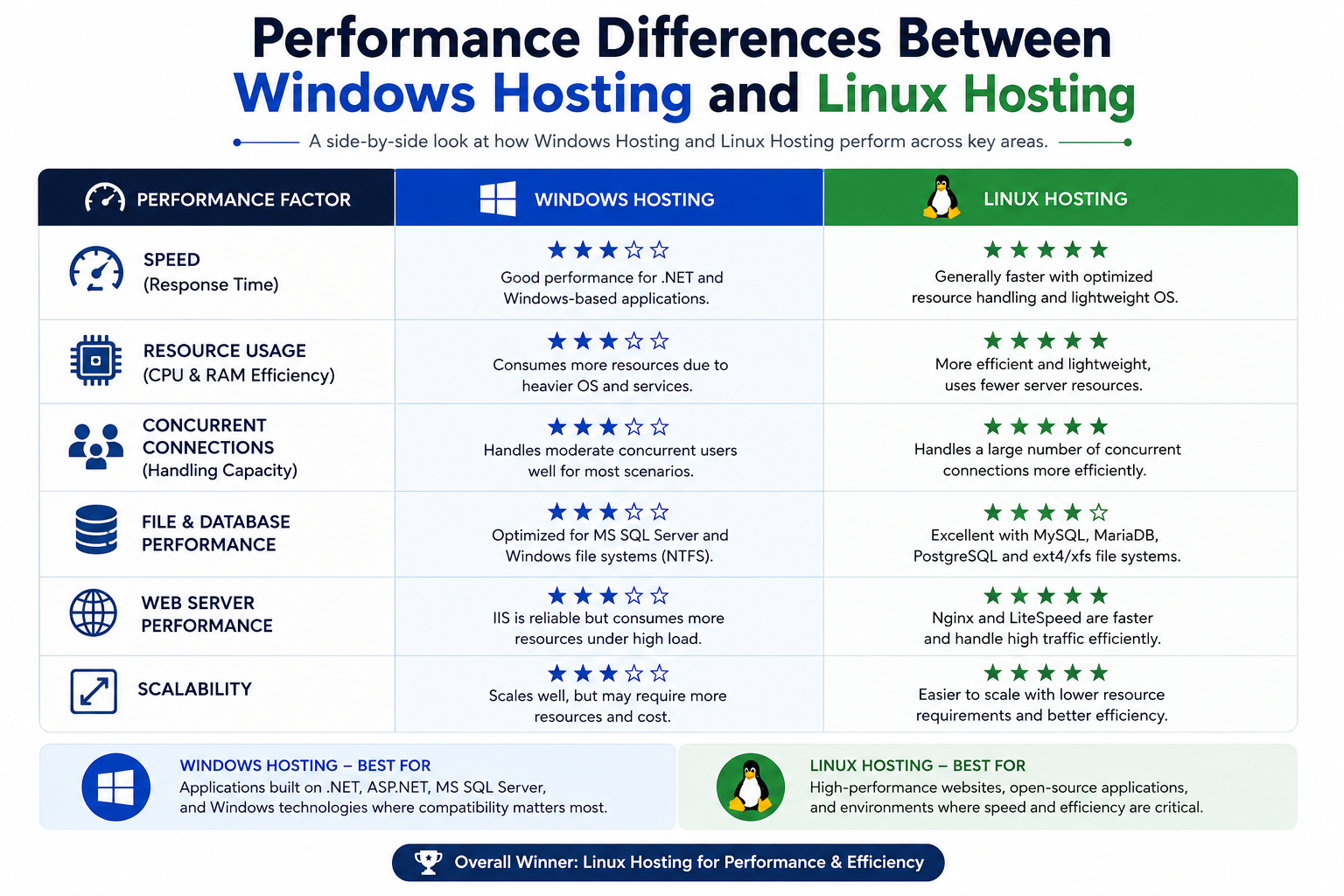
Performance Differences Between Windows Hosting and Linux Hosting
Performance comparisons between Windows and Linux hosting are often oversimplified online. The reality is that both platforms can perform extremely well when properly configured.
However, Linux hosting is generally considered more resource-efficient for traditional web hosting workloads.
Why Linux Hosting Often Feels Faster
Linux environments usually consume fewer server resources because they:
- Run fewer background services
- Have lower operating system overhead
- Handle web processes efficiently
- Scale well under concurrent traffic
- Work naturally with lightweight web server stacks
This is one reason many shared hosting providers prefer Linux-based environments for high-density hosting infrastructure.
Linux hosting also works exceptionally well with modern performance-focused stacks like:
- LiteSpeed + PHP
- NGINX reverse proxy environments
- optimized caching systems
Windows Hosting Performance Characteristics
Windows hosting is not inherently slow, but Windows Server environments typically require more RAM and system resources.
This happens because:
- Windows Server has heavier background services
- IIS consumes additional resources in certain workloads
- Microsoft licensing environments add operational complexity
That said, Windows hosting can perform extremely well for applications specifically designed for Microsoft ecosystems.
An ASP.NET business application hosted on properly optimized Windows infrastructure may outperform a poorly optimized Linux setup running incompatible technologies.
The operating system alone does not determine speed. Server optimization, hardware quality, caching, and infrastructure management all play major roles.
Software Compatibility Is the Most Important Factor
Compatibility should always be the first consideration when choosing between Windows and Linux hosting.
Choose Windows Hosting If Your Website Uses
- ASP.NET
- VB.NET
- MSSQL
- Windows-specific APIs
- Microsoft enterprise software
Choose Linux Hosting If Your Website Uses
- PHP
- WordPress
- Laravel
- Python
- Node.js
- MySQL
- MariaDB
- Open-source CMS platforms
This is where many beginners get confused.
Your personal computer operating system does not determine your hosting choice.
A Windows laptop user can use Linux hosting perfectly.
A Mac user can use Windows hosting perfectly.
What matters is the technology stack powering your website.
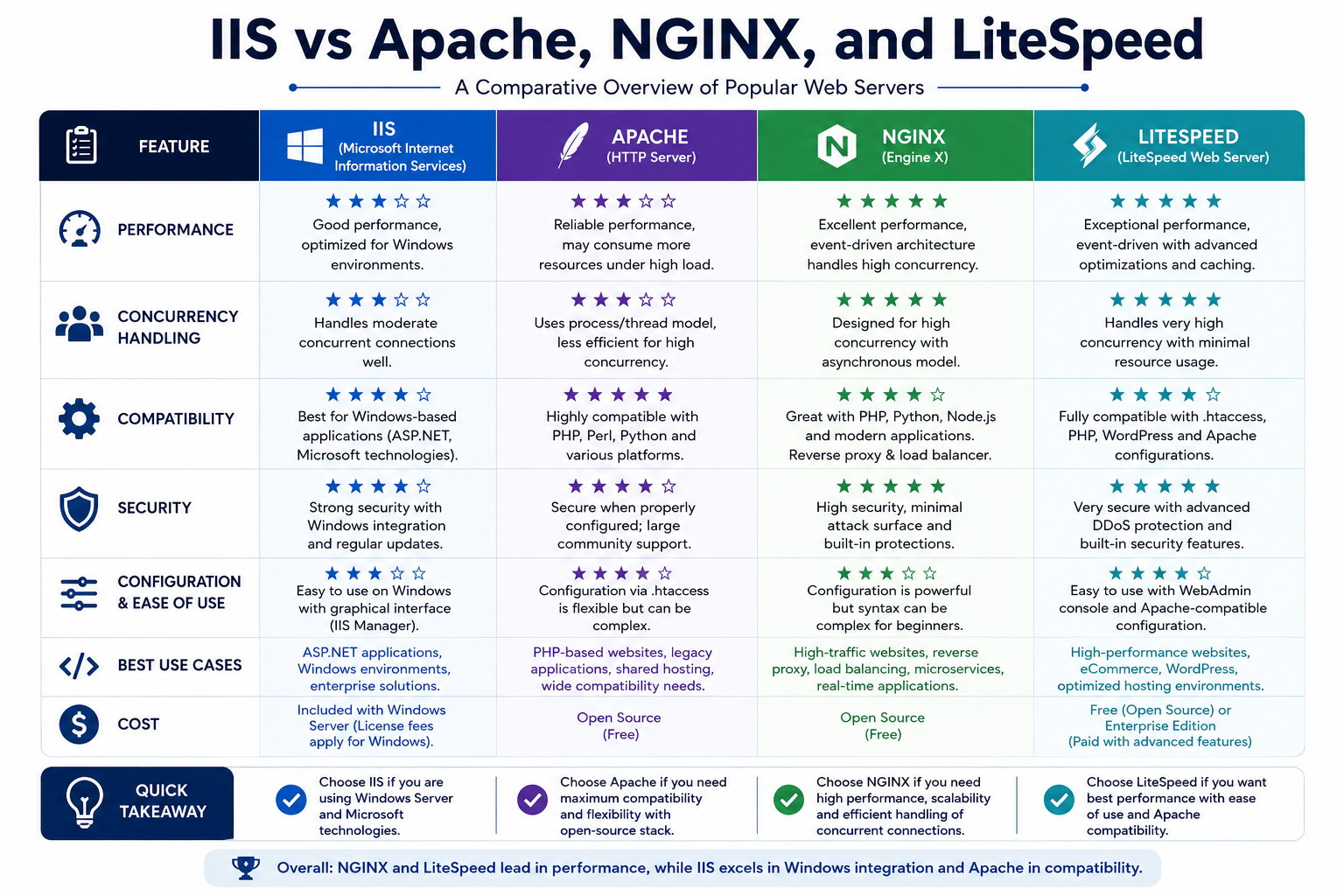
IIS vs Apache, NGINX, and LiteSpeed
One of the major architectural differences between Windows and Linux hosting is the web server software used.
Windows Hosting Typically Uses IIS
Windows hosting commonly relies on Microsoft IIS (Internet Information Services).
IIS integrates closely with:
- ASP.NET
- Windows authentication systems
- Microsoft server environments
It is widely used in enterprise infrastructure and Microsoft application deployments.
Linux Hosting Commonly Uses Apache, NGINX, or LiteSpeed
Linux hosting environments often use:
- Apache
- NGINX
- LiteSpeed
These web servers are extremely popular in open-source hosting ecosystems.
LiteSpeed, in particular, has become popular for high-performance WordPress hosting because of its efficient caching and low resource usage.
NGINX is widely used for handling high-concurrency traffic and reverse proxy environments.
Apache remains one of the most established web servers globally because of its flexibility and compatibility.
Control Panel Differences
The hosting control panel experience can vary between Windows and Linux environments.
Linux hosting commonly supports:
- cPanel
- DirectAdmin
- CyberPanel
- Plesk
Windows hosting commonly uses:
- Plesk
- SolidCP
- proprietary Microsoft-oriented panels
Plesk is especially popular because it supports both Linux and Windows hosting environments.
For beginners, the overall user experience is usually similar regardless of platform. Most control panels provide graphical interfaces for:
- file management
- email accounts
- databases
- SSL certificates
- backups
- domain configuration
The bigger differences exist behind the scenes in server compatibility and software support.
Security Differences Between Windows and Linux Hosting
Both Linux and Windows hosting can be highly secure when managed properly.
Linux hosting has historically gained a strong reputation in web hosting because of:
- granular permission systems
- lightweight architecture
- strong isolation models
- rapid open-source security patching
Linux servers also tend to run minimal environments, which can reduce unnecessary attack surfaces.
However, Windows hosting environments can also be extremely secure, especially in enterprise deployments with proper management practices.
In reality, most hosting security issues come from:
- outdated applications
- weak passwords
- vulnerable plugins
- poor server configuration
- unpatched software
The operating system alone does not guarantee security.
A poorly maintained Linux server can become vulnerable just as easily as a poorly maintained Windows server.
Cost Differences Between Windows and Linux Hosting
Windows hosting is usually more expensive than Linux hosting.
The biggest reason is licensing.
Windows Server environments require Microsoft licensing, which increases operational costs for hosting providers.
Linux hosting is often cheaper because:
- Linux operating systems are open source
- licensing costs are minimal
- resource usage is typically lower
- infrastructure density can be higher
For small websites, the price difference may not seem huge, but it becomes more noticeable in larger hosting environments or enterprise deployments.
This is one reason Linux hosting dominates the general web hosting market.
Best Hosting Choice for Different Website Types
The easiest way to choose between Windows and Linux hosting is to match the platform to your website’s technology stack.
Linux Hosting Is Usually Best For
- WordPress business websites
- WooCommerce stores
- blogs and content websites
- PHP applications
- Laravel SaaS platforms
- Magento ecommerce websites
- developer-focused web applications
Windows Hosting Is Usually Best For
- ASP.NET applications
- enterprise Microsoft software
- MSSQL-based applications
- Windows-authenticated business portals
- Microsoft-integrated internal systems
For most standard websites, Linux hosting is usually the more practical and cost-effective option.
For Microsoft-dependent applications, Windows hosting remains essential.
Modern .NET Applications Have Changed the Landscape
Historically, ASP.NET applications were tightly tied to Windows hosting environments.
However, modern .NET Core and newer .NET frameworks have introduced stronger cross-platform support.
Today, some Microsoft-based applications can run efficiently on Linux servers as well.
This has reduced the strict dependency on Windows hosting in certain development environments.
However, many enterprise systems still rely heavily on:
- IIS-specific configurations
- legacy Microsoft frameworks
- Windows authentication environments
- MSSQL integrations
So while the gap has narrowed somewhat, Windows hosting still plays an important role in Microsoft-centered infrastructures.
Migration Considerations Before Choosing a Platform
One important factor many users overlook is migration difficulty.
Switching between Linux and Windows hosting later can sometimes create compatibility challenges.
Moving From Linux to Windows
Possible issues include:
- PHP compatibility adjustments
- file permission differences
- URL rewriting changes
- server configuration differences
Moving From Windows to Linux
Possible issues include:
- ASP.NET dependency limitations
- MSSQL migration complexity
- IIS configuration incompatibility
- Windows-specific framework dependencies
This is why choosing the correct hosting platform early is important, especially for growing applications and business systems.
Common Misconceptions About Windows Hosting
“Windows Hosting Is Better for Windows Users”
This is false.
Your desktop operating system does not determine your hosting platform.
Hosting should be selected based on website compatibility, not personal computer preference.
“Linux Hosting Is Only for Developers”
Modern Linux hosting environments are highly beginner-friendly.
Most website owners never interact directly with Linux command lines.
Graphical control panels handle most administrative tasks.
“Windows Hosting Is Faster Because It’s Microsoft”
Performance depends on:
- server optimization
- hardware quality
- caching
- software stack efficiency
- workload compatibility
No hosting platform is automatically faster in every situation.