Who Needs VPS Hosting? A Guide for Businesses and Websites
Not every website needs a VPS, but there comes a point when shared hosting may no longer meet a website’s resource or configuration requirements. Growing businesses, developers, online stores, and organizations running custom applications may benefit from moving to a Virtual Private Server (VPS). But how do you know when VPS hosting is necessary? Understanding […]

Not every website needs a VPS, but there comes a point when shared hosting may no longer meet a website’s resource or configuration requirements. Growing businesses, developers, online stores, and organizations running custom applications may benefit from moving to a Virtual Private Server (VPS).
But how do you know when VPS hosting is necessary? Understanding your website’s resource requirements, traffic patterns, and server management needs can help you decide whether a VPS is the right choice.
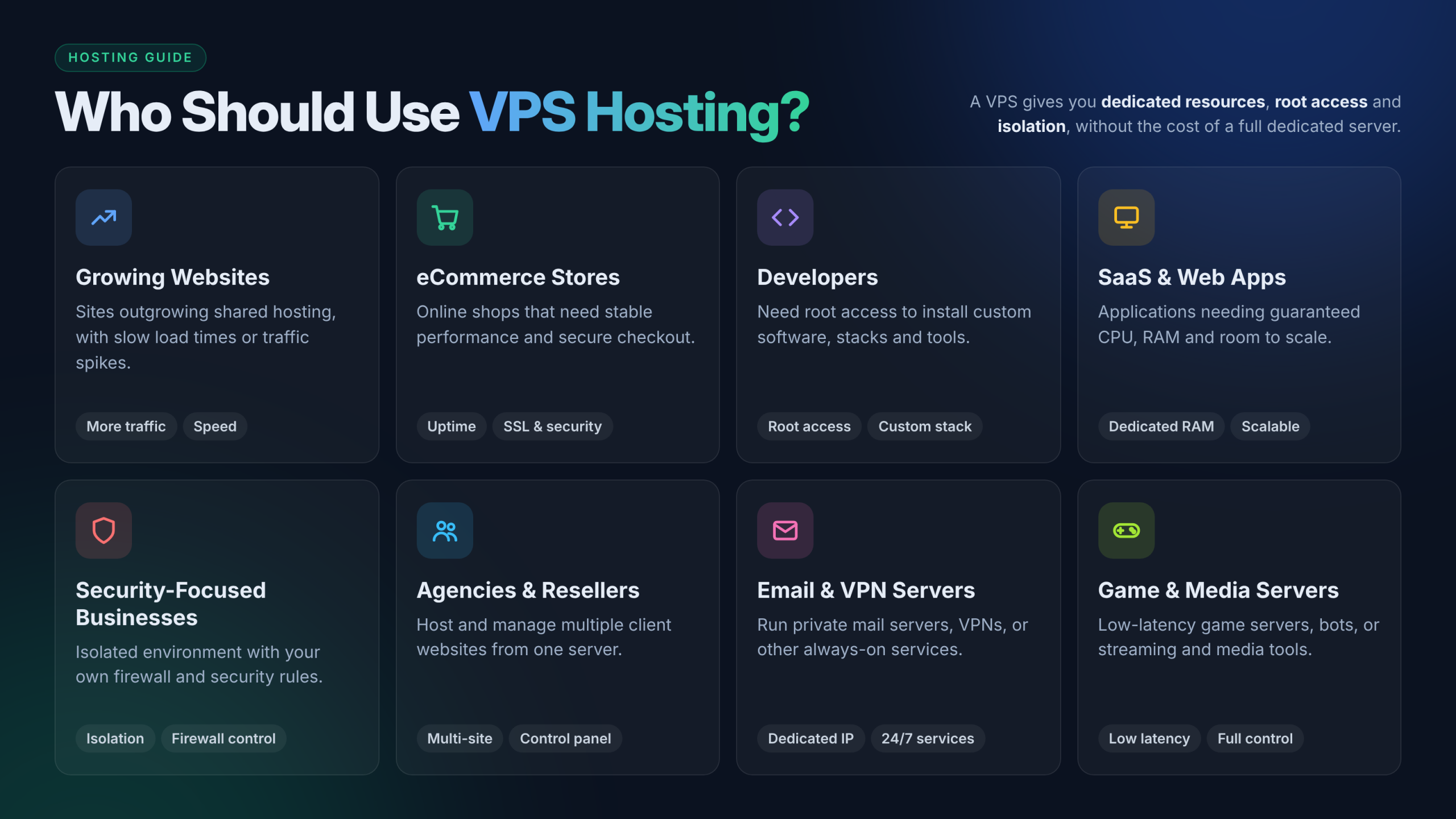
Who Should Use VPS Hosting?
VPS hosting is particularly useful for websites and applications that need more control, allocated resources, or flexibility than standard shared hosting provides. The following are common situations where a VPS may be a suitable option.
1. Growing Businesses and Websites
Small businesses often start with shared hosting because it is affordable and easy to manage. As their websites grow, however, their hosting requirements may change.
A growing business may consider VPS hosting when it experiences:
- Increasing website traffic and resource consumption.
- Frequent CPU or memory limit warnings.
- More demanding website functionality.
- Additional business applications.
- A need for greater server configuration flexibility.
A VPS provides an isolated virtual server environment with allocated resources, giving businesses more control over how their websites and applications operate.
However, increasing traffic alone does not automatically mean a VPS is necessary. Website optimization and the limitations of the existing hosting plan should also be evaluated.
2. E-commerce and WooCommerce Stores
Online stores handle dynamic content, customer accounts, product catalogues, shopping carts, and database transactions. These activities can create additional demands on hosting resources as a business grows.
VPS hosting can be useful for e-commerce websites that need:
- More allocated CPU and RAM resources.
- Greater control over PHP and database configurations.
- Custom caching and server optimization.
- Support for additional applications and integrations.
- More flexibility as the store expands.
It can be particularly suitable for growing WooCommerce stores and other self-hosted e-commerce platforms.
However, a VPS does not automatically guarantee faster checkout processing or better website performance. Database optimization, caching, application efficiency, and appropriate server resources remain important.
3. Developers and Web Development Agencies
Developers often need more control over their hosting environments than shared hosting allows.
A VPS provides administrative access and the flexibility to install software, configure services, and manage application environments.
Developers and agencies can use VPS hosting for:
- Testing and deploying web applications.
- Creating development and staging environments.
- Running custom scripts and background processes.
- Managing databases and web server configurations.
- Hosting multiple client websites.
- Installing specific software packages and dependencies.
This makes VPS hosting a practical option for development teams that need greater control over their server environments.
4. Businesses Running Custom Applications
Some business applications require specific software versions, custom configurations, or background services that may not be supported by standard shared hosting.
Examples include:
- Customer Relationship Management (CRM) systems.
- Enterprise Resource Planning (ERP) applications.
- Custom business management software.
- API services and application backends.
- Internal business portals.
- Database-driven applications.
A VPS allows administrators to configure the operating system and server environment according to application requirements, provided the selected VPS plan supports the necessary software.
5. WordPress Websites With Higher Resource Requirements
Many WordPress websites operate successfully on shared hosting. However, more complex installations may require additional resources and server configuration flexibility.
This can include websites with:
- High visitor traffic.
- Large databases and extensive content.
- Complex themes and page builders.
- Resource-intensive plugins.
- WooCommerce functionality.
- Background processing requirements.
A VPS can provide additional allocated resources and greater control over PHP, database, caching, and web server configurations.
However, moving to VPS hosting should not be the first solution to every slow WordPress website. Poorly optimized plugins, oversized images, inefficient themes, and database problems can also affect performance.
Website owners should identify the actual performance bottleneck before upgrading.
6. Organizations That Need Greater Server Control
Some organizations require administrative access to configure their hosting environment beyond the restrictions of shared hosting.
For example, they may need to:
- Install custom software and applications.
- Configure firewall rules and security policies.
- Manage server services and processes.
- Select specific operating system packages.
- Customize web server settings.
- Manage application-level configurations.
A VPS generally provides root access on Linux or administrator-level access on supported Windows Server environments.
This flexibility is useful for organizations with technical staff or administrators who need direct control over their server environment.
How Do You Know When You Need VPS Hosting?
You may need to consider upgrading to VPS hosting when your current hosting environment consistently struggles to meet your website’s requirements.
Look for these common indicators:
| Warning sign | What it may indicate |
| Frequent CPU or RAM limit warnings | Your current hosting resources may be insufficient |
| High resource consumption | Your application may need more allocated resources |
| Performance problems during busy periods | Your hosting environment may struggle with workload peaks |
| Restrictions on software installation | You may need greater server control |
| Background processes cannot run properly | Your application may require a more flexible environment |
| Multiple applications with different requirements | A VPS may provide better configuration flexibility |
Before upgrading, examine your hosting account’s resource usage and application performance.
Useful areas to investigate include:
- CPU and memory consumption.
- Disk space and disk I/O usage.
- PHP process and database activity.
- Website traffic patterns.
- Application and server error logs.
Sometimes optimizing your website or upgrading to a higher shared hosting plan can solve the problem without requiring a VPS.
Shared Hosting or VPS Hosting: Which Do You Need?
The right hosting environment depends on your website’s requirements, expected workload, budget, and technical management capabilities.
| Website or user type | Suitable hosting option |
| Personal blog with limited traffic | Shared hosting |
| Small business website | Shared hosting |
| Growing business website | Shared or VPS, depending on resource requirements |
| Busy WooCommerce store | VPS or suitable managed hosting |
| Development and testing environment | VPS |
| Custom business application | VPS |
| High-resource website | VPS or dedicated server, depending on workload |
These are general recommendations rather than fixed rules. A well-optimized website may perform effectively on shared hosting, while a poorly configured application may struggle even on a VPS.
The important consideration is whether your current hosting environment can support your actual workload.
Do You Need Technical Knowledge to Use VPS Hosting?
VPS hosting provides more flexibility than shared hosting, but it also introduces additional server management responsibilities.
With an unmanaged VPS, customers are generally responsible for tasks such as:
- Operating system installation and updates.
- Server security and firewall configuration.
- Software and application maintenance.
- Resource monitoring.
- Backup configuration and recovery.
- Troubleshooting server-related issues.
If you have the technical knowledge to manage these responsibilities, an unmanaged VPS may offer the flexibility you need.
If you prefer professional assistance, managed VPS hosting may be more appropriate. However, management services vary between providers, so check exactly what is included, such as operating system maintenance, security updates, backups, monitoring, and technical support.